RoHS & REACH Compliant · ANSI/ESD S20.20 Certified · DoD-Grade Packaging Materials
Electrostatic discharge (ESD) is one of the most preventable yet most damaging failure modes in advanced electronics.
In aerospace, defense, medical, and satellite systems, latent ESD failures are catastrophic:
- Flight termination
- Loss of vehicle or payload
- Mission abort
- Warranty & investigation costs
- Safety and lives at risk
The root cause often traces back to the first step in the supply chain:
Packaging and material handling inside the SMT line.
TapeSplice ensures compliance from the reel outward, protecting components before, during, and after assembly.
Why ESD Compliance Matters More in High-Reliability Programs
Devices are shrinking. Failure risks are growing.
- Smaller transistor gates burn more easily
- Latent defects escape test and fail in the field
- High-speed feeders multiply handling charge events
- Mission-critical boards cannot accept single-point failure
ESD protection is not paperwork —
it is risk elimination.
“If packaging fails ESD protection, the mission can fail before launch.”
Core Global ESD Standards – Required for Defense OEM Qualification
TapeSplice products and procedures conform to:
| Standard | Application |
|---|
| ANSI/ESD S20.20 | Facility ESD control, grounding, EPA maintenance |
| IEC 61340-5-1 | Handling & packaging of ESD-sensitive devices |
| ANSI/ESD TR53 | Verification test methods |
| ASTM F-150 | Static decay behavior |
| EIA-481 | SMT reel geometry & feeder alignment |
These are enforced by major aerospace primes, Tier-1 defense contractors, and critical suppliers worldwide.
What Does an ESD-Protected SMT Environment Require?
A certified Electrostatic Protected Area (EPA) integrates:
- Properly grounded dissipative floors & work surfaces
- Operator grounding (wrist strap, heel grounding)
- Static-shielding component packaging & reels
- Controlled environment 40–60% RH (55% ideal)
- Certified tools, carts, trays & PPE
- Regular EPA audits & procedural discipline
- Full documentation & traceability
If any of these controls fail → ESD escapes.
Essential ESD Test Procedures in Aerospace Electronics
These procedures are required documentation for most defense RFQs:
-
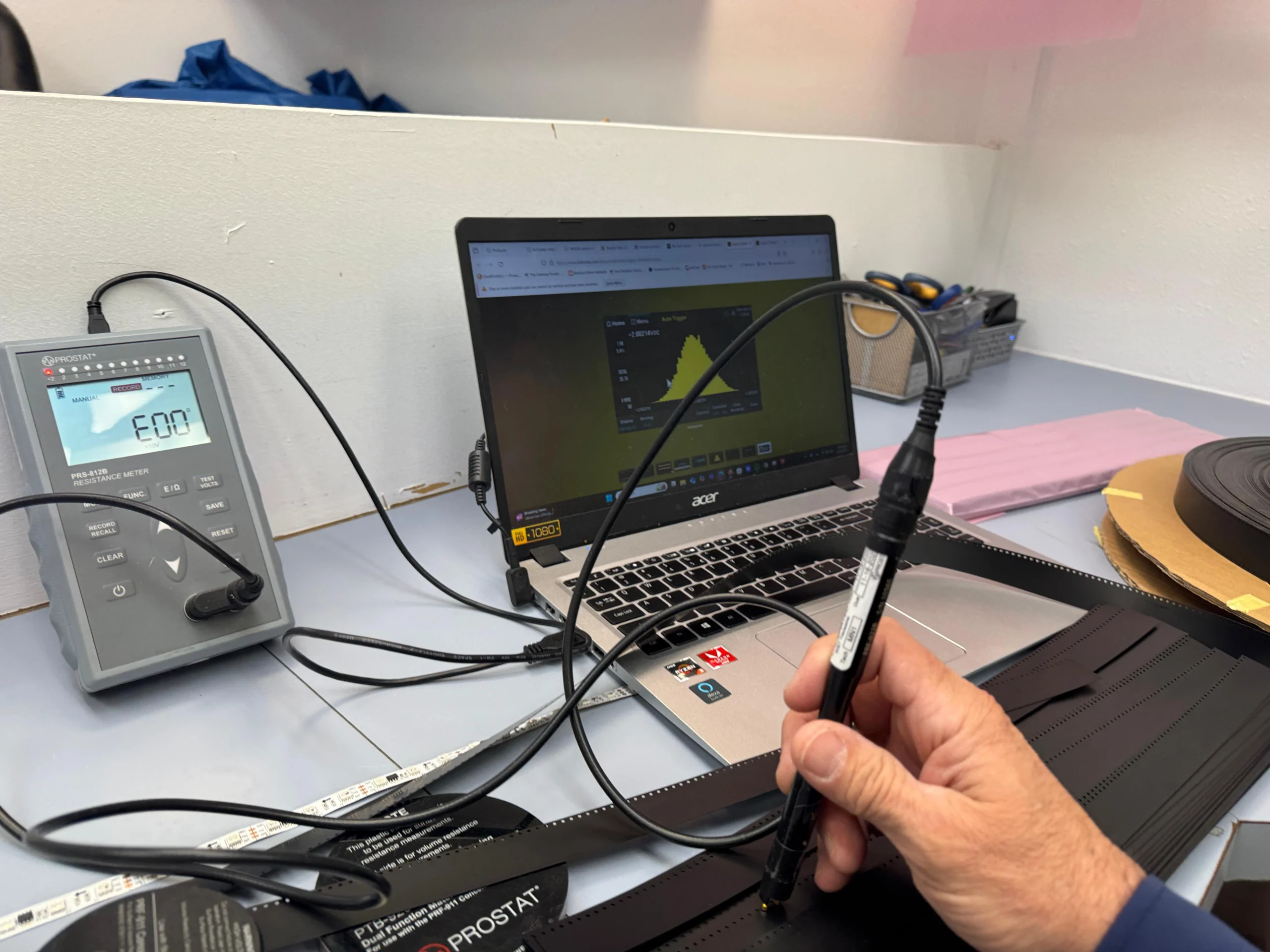
Resistance-to-Ground (RTG)
Measures how well the workstation discharges static to earth ground
Compliant range: 1×10⁴ – 1×10¹¹ Ω
-
Point-to-Point Resistance (RTP)
Validates uniform dissipation across surfaces
Should remain within similar range to RTG measurements
-
Charge Generation Testing
Performed on:
- SMT tape during friction handling
- Reel unspool and feeder acceleration
- Covertape peel
Targets:
< ±50 V (handling)
< ±100 V (peel separation)
-
Charge Decay Time
How quickly static charges dissipate after handling
Requirement: < 1 second
-
Ground Continuity Audits
All floors, benches, and tools verified < 1 Ω to earth ground
-
Workstation & Tool Qualification
Every item touching a component must be:
- Verified dissipative
- Connected to ground properly
Operators cannot touch, move, or load components unless grounded.
Why SMT Packaging Is a Top Source of ESD Failure
Packaging is constant contact with electronics:
- Thousands of mechanical events per shift
- High friction zones (covertape separation)
- Long-term storage = long-term charge buildup
If packaging is not dissipative:
- Electrostatic fields build inside pockets
- Charge transfers to silicon during automated pick
- Failure may not show until months later
This is why ESD compliance begins at the carrier tape and reel.
TapeSplice ESD-Compliant SMT Packaging
Our static-dissipative materials protect components from the first meter of tape to the last:
- Static-controlled PET and paper carrier tape
- Antistatic covertape with low-charge peel characteristics
- Leader tape with verified ESD performance
- U.S.-manufactured splice zones and connectors that preserve conduction pathways
Our materials are tested for safe charge decay and zero IC damage during automated placement.
Maintaining ESD Compliance, Operational Best Practices
ESD compliance is a continuous process:
- Daily ground checks of wrist straps
- Weekly mat & floor verification
- Monthly EPA audit & documentation
- Conditioning mats with ESD cleansers, not alcohol
- Replace degraded materials before failure
Employees must receive:
- Annual ESD training certification
- Immediate retraining if noncompliance occurs
One untrained operator can compromise an entire program.
Integration with High-Speed SMT Lines
TapeSplice packaging supports precision feeder alignment for:
- Fuji
- Panasonic
- Juki
- Samsung/Hanwha
- ASM/Siemens
- Universal
- Mycronic/Mydata
- Sanyo and others
Charge control keeps:
- Pocket retention high
- Pick-rates consistent
- No-pop stability during impact forces >40,000 CPH
U.S. Manufacturing Advantage
Sierra Electronics maintains:
- ANSI/ESD S20.20-certified EPA
- RoHS and REACH compliant materials
- Digi-Key qualified product line
- 100% traceable U.S. sourcing
No gray-market chemistry.
No off-shore contamination.
No question where your material came from.
This is what mission critical packaging requires.
When Failure Isn’t an Option, Choose ESD First
You can choose:
- Cheaper tape and accept risk
- Certified static-safe materials and ensure mission success
There is no middle ground.
Protect the electronics that protect people.
Ready to upgrade your ESD control program?
- Request Certification: ANSI/ESD S20.20 & RoHS/REACH Documentation
- Shop Static-Safe SMT Reels & Tape
- Talk to Our Aerospace Packaging Specialists