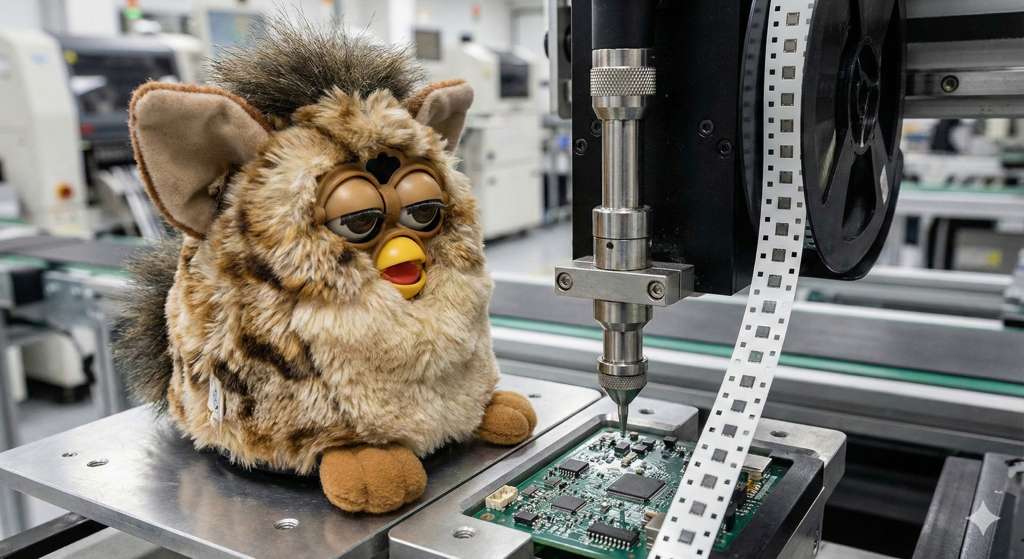
Vision systems. Placement speed. Throughput charts.
40,000 CPH becomes the headline and everything below it disappears.
It was mechanics.
And it came from Hollywood.
Decades before surface-mount manufacturing scaled, the motion picture industry had already solved a brutal production problem: how to move fragile, discrete units through a machine at constant speed with perfect positional repeatability.
They didn’t correct position.
They relied on sprocket-driven motion and fixed geometry.
Frame after frame.
No sensors.
No feedback.
Just predictable physics.
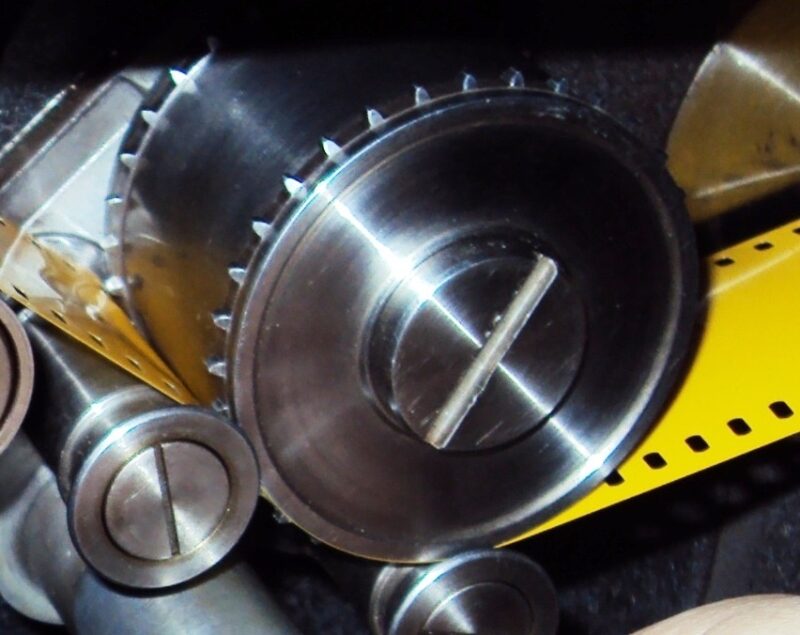 When electronics manufacturing began scaling integrated circuits, engineers ran into the exact same constraint. You cannot look for parts at speed. You must assume geometry is correct or the line collapses.
That assumption became unavoidable in the late 1990s when high-volume consumer products exploded. One of the most visible examples was Furby. Suddenly millions of identical IC-driven units had to be assembled quickly, cheaply, and consistently. Lines could not slow down. Accuracy could not slip. Scrap could not spike.
Furby didn’t invent SMT, but it forced SMT to grow up.
Some early designs even experimented with square or rectangular sprocket holes inspired by film geometry.
At low speeds, it worked.
At higher speeds, physics won.
Square geometry introduced stress concentration, uneven engagement, and accelerated wear. The bottleneck wasn’t electronics. It wasn’t vision systems. It was mechanics.
The standard did not invent indexing. It refined Hollywood’s solution for industrial scale.
 Round metric sprocket holes distributed load evenly, reduced wear, and enabled predictable engagement at high acceleration. That single mechanical decision is what made modern high-speed SMT feeders possible.
EIA-481 did not standardize convenience.
It standardized mechanical reality.
Today SMT feeders operate open-loop. They do not hunt for pockets. They do not correct position dynamically. They assume geometry is correct. That assumption is what allows speed, live splicing, and placement accuracy without constant correction.
We still use reels.
We still use sprockets.
We still advance components frame by frame.
In fact, some of the same U.S. manufacturers that produced movie reels for Hollywood still manufacture reels for the electronics industry today, including nearly identical 8 mm formats used for SMD components.
Different industry.
Same physics.
Same geometry.
Same solution.
Modern SMT inherited motion from Hollywood, discipline from physics, and scale pressure from products like Furby. What looks like cutting-edge electronics manufacturing is built on century-old mechanical certainty.
Frame by frame.
Pocket by pocket.