Why Most Splice Failures Are Engineered Into the Adhesive Choice
 In surface mount manufacturing, splice tape performance is not a branding issue or an installation issue. It is a physics issue.
Most SMT splice failures happen because the adhesive system was selected and qualified around peel strength, while the production environment applies sustained shear load, acceleration spikes, and time-dependent creep.
This mismatch is the root cause behind intermittent feeder stoppages, fishtailing, and unexplained line interruptions that erode OEE.
This post breaks down the difference between peel strength and shear strength, explains why SMT feeders care almost exclusively about shear, and shows how to evaluate splice tape correctly for real production conditions.
Peel Strength
What It Measures
Peel strength measures the force required to remove tape by lifting it away from a surface at a defined angle, typically 90 or 180 degrees.
It answers the question:
How hard is it to peel this tape off by hand?
This metric is useful for:
- Labels
- Protective films
- Packaging tapes
- Applications where removal force matters
It is not representative of how SMT splice tape is loaded in a feeder.
Why Peel Strength Is Misleading in SMT
Peel testing:
- Applies force perpendicular to the bond line
- Happens over seconds
- Encourages adhesive stretching and release
- Makes soft rubber adhesives look strong
In contrast, SMT feeders almost never apply peel forces during normal operation.
Shear Strength
What It Measures
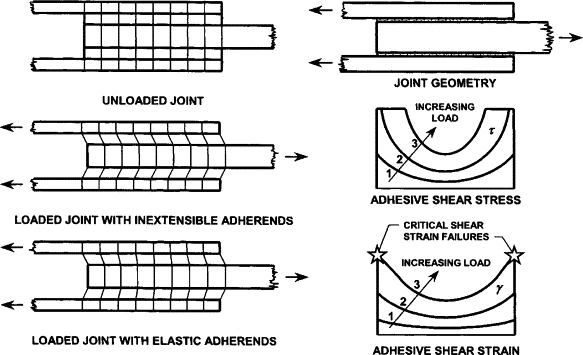
Shear strength measures the adhesive’s ability to resist sliding forces parallel to the bond line under load over time.
It answers the question:
Can this adhesive hold two materials together while being pulled continuously in one direction?
This is exactly how splice tape is stressed inside a feeder.
Why Shear Dominates in SMT Feeders
Once a splice enters the feeder:
- The carrier tape is under constant tension
- The drive sprocket pulls forward continuously
- Indexing introduces repeated acceleration spikes
- The load is applied parallel to the adhesive layer
There is no peeling action. The splice is being dragged forward hundreds or thousands of times per shift.
The Three Forces That Kill Weak Splices
Sustained Shear Load
The feeder applies constant tension to the carrier tape. Adhesives with poor shear resistance slowly deform under this load.
This leads to:
- Adhesive creep
- Gradual splice elongation
- Hole pitch distortion
- Eventual separation
Acceleration Induced Tension Spikes
Every index cycle introduces a brief but sharp force spike. Adhesives optimized for peel often fail here because they:
- Stretch instead of resisting
- Do not recover their original thickness
- Lose positional accuracy
Time Dependent Adhesive Creep
Some adhesives do not fail immediately. They creep.
The splice looks fine:
- At setup
- During first articles
- For the first reel
Then it fails mid-run when deformation crosses a critical threshold.
These are the worst failures because they appear random.
Why High Peel Adhesives Often Fail First
Many low-cost splice tapes use soft rubber or acrylic systems designed to inflate peel numbers on datasheets.
These adhesives:
- Wet out easily
- Feel aggressive to the touch
- Test well in peel labs
- Perform poorly under shear
In SMT, high peel often correlates with low internal cohesion, which accelerates creep and delamination under feeder tension.
What Actually Makes a Reliable SMT Splice
A splice that survives real production has:
- High static shear resistance
- Minimal cold flow
- Controlled adhesive thickness
- Stable modulus across temperature
- Strong adhesion to PET carrier tape
Peel strength still matters, but only as a secondary property. It should be sufficient for handling, not maximized at the expense of shear.
How to Evaluate Splice Tape the Right Way
If you want to qualify splice tape for real SMT use, stop asking for peel numbers alone.
Instead, ask:
- What is the adhesive’s static shear rating at load
- How does it behave after 24 hours under tension
- Does the adhesive creep at feeder temperatures
- Is thickness controlled tightly across the roll
- Has it been tested on actual feeders
A simple internal test is to apply a splice under tension and leave it loaded overnight. The tapes that fail in production usually show visible deformation long before they detach.
The Bottom Line
SMT feeders do not peel splices apart.
They pull them forward relentlessly.
Designing splice tape around peel strength is like designing a bridge around paint adhesion instead of load-bearing capacity.
If you want fewer line stops, fewer mystery failures, and higher OEE, evaluate splice tape the way feeders actually stress it.
Shear strength keeps the line running. Peel strength just feels strong in your hand.